Persian and Exotic Shorthair FAQ
These are the questions we get asked most, written out so you can read them at midnight instead. They cover the breeds themselves, what our kittens cost, how buying works and what to ask any breeder before you pay a deposit.
What is a Persian cat?
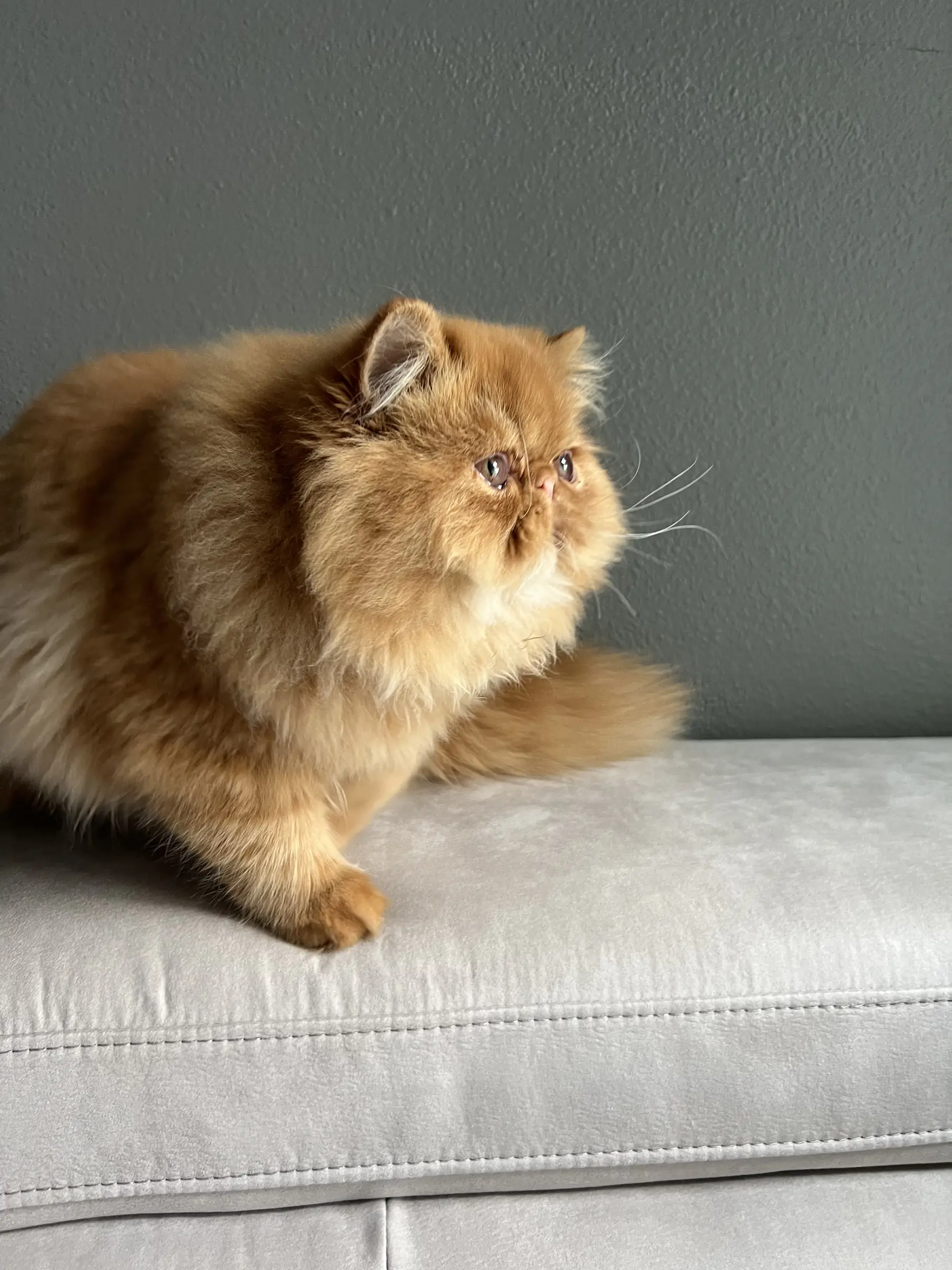
A Persian is a longhaired purebred cat recognized by its round head, short muzzle, small ears, large round eyes and a long dense double coat. Persians are calm, quiet, low energy companion cats that prefer floor level to high shelves and tolerate handling unusually well.
What is an Exotic Shorthair?
An Exotic Shorthair is a Persian in a short coat. It was created by crossing Persians with American Shorthairs, and it shares the Persian head type, body and temperament while needing far less grooming. Breeders often call it the lazy person's Persian.
Which is better for a first time owner, a Persian or an Exotic Shorthair?
An Exotic Shorthair, in most cases. The temperament is the same, but the grooming commitment is two or three brushings a week rather than a daily comb through. If you know you will do the daily grooming, a Persian is just as manageable.
How much grooming does a Persian need?
A Persian needs combing every day, roughly five to ten minutes. Skipping a few days lets mats form behind the ears, in the armpits and along the back legs, and a serious mat has to be cut out by a groomer. Daily combing also cuts hairballs sharply.
Do Persian cats shed a lot?
Yes. Persians shed year round and more heavily in spring. Daily combing removes most of the loose coat before it reaches your furniture. Exotic Shorthairs shed a similar volume of hair but the shorter hairs are far less visible.
Are Persian cats good with children and dogs?
Generally yes, provided the children are old enough to be gentle. Persians are placid and rarely scratch, but they are not a breed that enjoys rough handling or being chased. They usually settle well with calm dogs after a proper introduction.
How long do Persian cats live?
A well cared for indoor Persian typically lives twelve to sixteen years. Keeping the cat indoors, at a healthy weight, on annual vet checks and with a groomed coat is what pushes a cat toward the upper end of that range.
Why do Persian cats get tear stains?
The flat face shortens the tear ducts, so tears run onto the fur instead of draining. It is normal for the breed and is managed by wiping the eye folds daily with a damp cloth or a veterinary eye wash. Sudden heavy discharge, squinting or a colored discharge means a vet visit.
How much does a Persian kitten cost?
Persian kittens from registered breeders in the United States usually cost about $1,300 to $3,500. Our kittens are $1,700 to $2,000. A purebred Persian offered for a few hundred dollars is almost always either not purebred or not healthy.
Do you sell kittens to buyers in other states?
Yes. We are in Vancouver, Washington and we send kittens all over the country. Your kitten never travels as cargo: it flies in the aircraft cabin with a person, either you after collecting it at Portland International, one of us, or a flight nanny we have used. There is a full page on buying from another state.
Do you ship kittens?
We never ship as cargo, but we do send kittens to other states. Your kitten flies in the cabin with a person: either you collect it in Vancouver or at Portland International Airport, or we fly it to your nearest airport ourselves, or send it with a flight nanny we have used, PDX Flight Nanny.
Can I visit the cattery?
Yes, by appointment. Our cattery is inside our home, so we share the exact address once a visit is scheduled. Visiting is the best way to see how kittens are raised, and we encourage it for local buyers.
Are your cats registered with TICA and CFA?
What testing have the parents had?
Every breeding cat here is screened on a genetic panel and is negative for polycystic kidney disease. PKD has long been present in Persian lines. It shows on a DNA test, so we test for it. All of our cats also test negative for feline leukemia and FIV, which are blood tests rather than DNA. Ask us and we will send you the results for a particular kitten's parents.
What should I ask a cat breeder before buying?
Ask to see both parents, ask for the pedigree, ask what age kittens go home, ask what the health guarantee actually covers in writing, and ask to speak to a previous buyer. If a breeder dodges any of the five, walk away.
Should I get one kitten or two?
If the house is empty most of the day, two settle better than one and entertain each other. If someone is home most of the time, one is fine. Persians are companionable but not as prone to separation stress as some breeds.
Did we miss your question?
Send it through the contact form. If it is a good question we will add it to this page.
Page last reviewed and updated on by Exotic Stars Cattery.
Ready to look at kittens?
Prices, birth dates and parents are published for every kitten we have available.